Anyang at the Dawn of the Day: The City Dreaming of a Utopia
Single-channel video installation
with two pencil drawings, 125×440cm, 125×428cm
color, 5,1 sound channel, 33min
Moving spotlight with interface controller, 2014
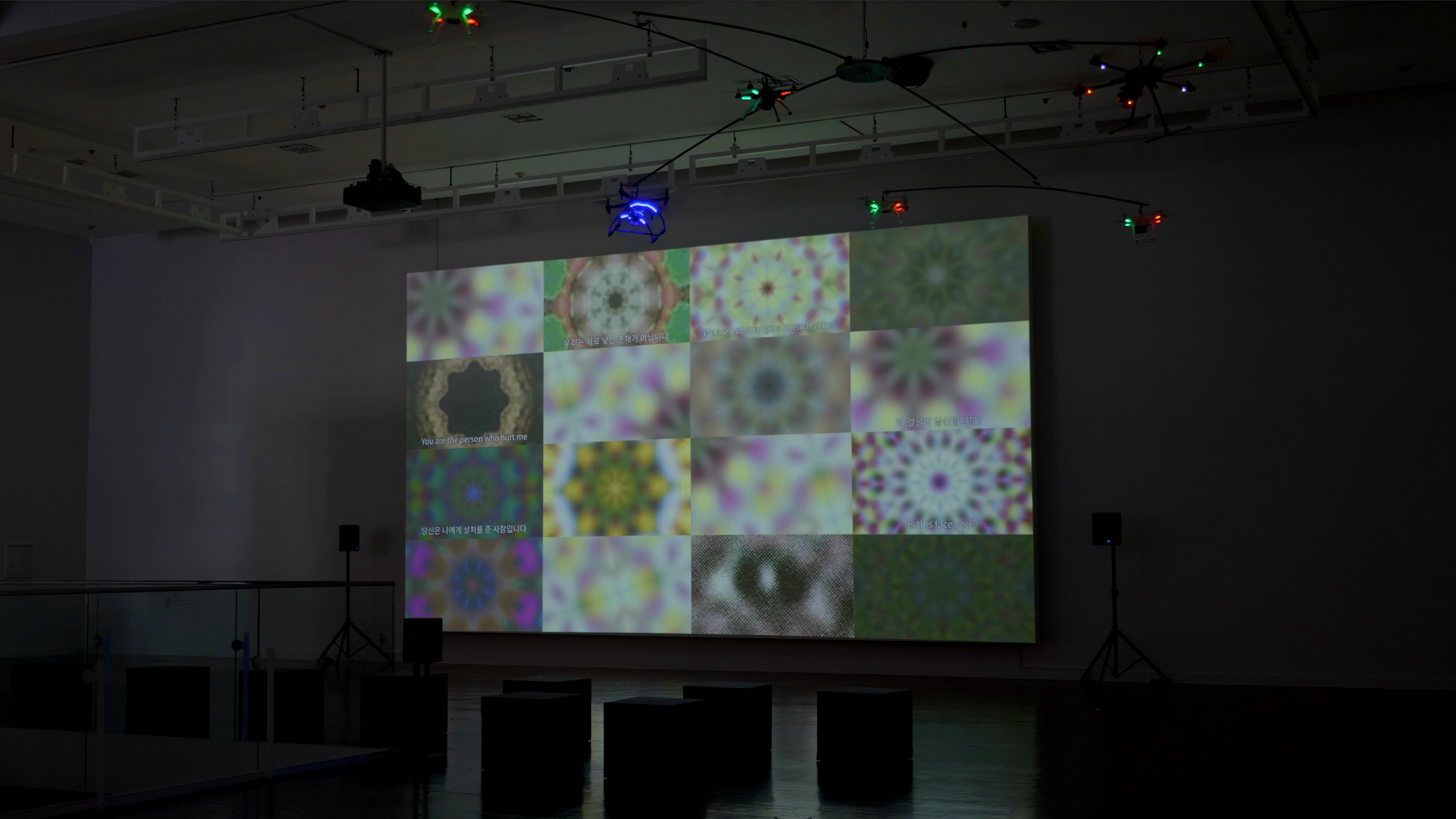
Installation view Anyang at the Dawn of the Day, The City Dreaming of a Utopia
The name of the city Anyang (translated as the “Land of Bliss”) stands for a blissful place where everyone lives in peace and joy, without any pain. Inspired by the city’s name, artist Song Sanghee embarks on an exploration in search for the utopian aspects of the city, visiting 33 different places, in which is included the usual urban establishments found in any other place such as a post office, park, and traditional outdoor market, as well as establishments particular to the city, such as the Animal and Plant Quarantine Agency, the Korea Seed & Variety Service, the National Radio Research Agency, and former Seoi-myeon Office. In the process she discovers that Anyang is just an ordinary city that is in fact far from the ideal.
However seeing the city’s landscapes at dawn, quite different from the day, the artist senses the bottled up energy ripe for explosion, with its true nature masked by the thick layers of the common exterior. Here, the artist introduces a chilling thought: Perhaps, these establishments created to make our lives more comfortable, including governmental authorities, educational institutions, and recreational facilities, are, in reality, part of a dark system that categorizes, brainwashes, and sensors human society, destroying our private lives and taking control of everything based on a grand, sinister design. Anyang at the Dawn of the Day: The City Dreaming of a Utopia is a playful story of a dystopia, based on a fictional premise that behind this ordinary and peaceful façade, lurks a dark force that conspires to brainwash the human race.
In order to weave this fictional narrative set, the artist quotes phrases from eight different books, including Perfect Society by Moon Yun-seong (1967), Brave New World by Aldous Huxley (1932), and 1984 by George Orwell (1949). The narrative is mostly composed of sentences directly quoted from the novels or paraphrased by the artist, and introduces her own writing as little as possible. Such an approach allowed the artist to limit her role to the editor and prevent herself from assuming the role of the creator. This also shows an attitude commonly found in female artists who, rather than making forceful intervention, choose to take a step back and observe. The video camera, too, remains still, capturing only subtle movements occurring in the space and helping the artist remain as an observer, instead of becoming the director. The artist chooses to wait “quietly with an anticipation, to capture something that is not obvious yet visible, like air or sound, as I look into the space absently for a while, hoping for something to happen, for someone to pass.”
The thirty minute video is installed with two black-and-white drawings, creating a sort of a triptych. A juxtaposition of metaphoric or metonymic images referring to various elements of the video, these drawings are lit by moving spotlights in sync with the video

Installation view Anyang at the Dawn of the Day, The City Dreaming of a Utopia
Single-channel video installation with two pencil drawings, 125×440cm, 125×428cm
color, 5,1 sound channel, 33min, Moving spotlight with interface controller, 2014


Still image
Anyang at the Dawn of the Day,
The City Dreaming of a Utopia